
Sep 24, 2026Applications
Best Cummins Diesel Engine for Concrete Pump Trucks
A Cummins concrete pump engine is sized by placing output and boom reach, not peak horsepower. Match the pumping duty to the right Cummins family, derate for the site, then verify the nameplate.
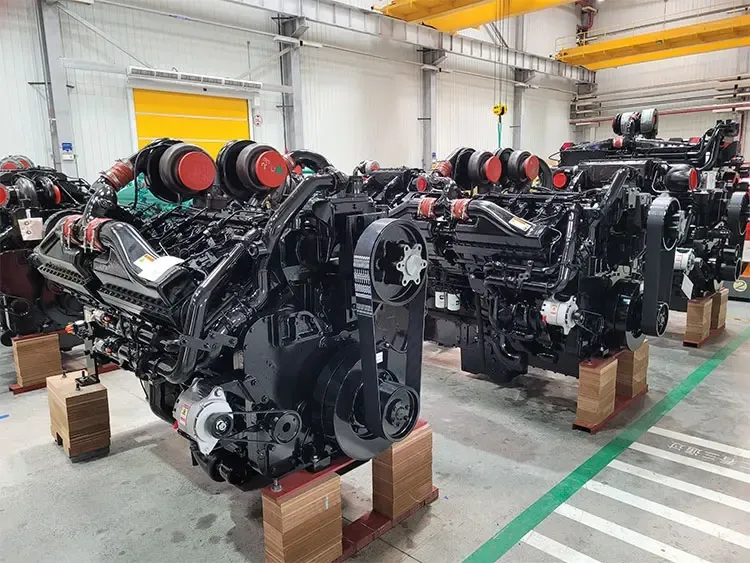
By the Cummins Motor Team — the engineers and export specialists at Cummins Motor Co., Ltd., Xiangyang, China, who quote, inspect and load-test these engines.
A Cummins concrete pump engine is chosen by the concrete it must place, not by a horsepower number on its own. Output volume, delivery pressure and boom reach decide how much sustained power the chassis engine has to hold.
Most mistakes happen because the engine is picked from a truck catalogue that never saw a pumping shift — continuous load, a pulsating piston cycle and a hydraulic pump drawing from the same engine that moved the truck to the site.
A concrete pump runs one engine for two jobs. The same Cummins that drove the truck to the site also drives the hydraulic pump that places the concrete, so it must hold its speed under both.
1. Start With the Pump's Output and Reach, Not the Engine Model
Concrete pump trucks are sized by placing output and vertical reach rather than by a single horsepower target. A small trailer pump and a sixty-metre boom pump sit in completely different bands.
Those two numbers — cubic metres per hour and the height or distance the line must carry — decide the hydraulic flow and pressure the engine must sustain. Displacement and cylinder count are consequences of that demand, not the starting point.
Write down the pump's rated output and the longest vertical run first. The engine you specify has to hold the pumping speed after the PTO, the hydraulic pump and the cooling fan have taken their share.
2. Why a Pump Truck Is a Constant-Speed, High-Duty Problem
Pumping is a sustained load, not an intermittent one. Unlike a tipper that lifts for a minute, a pump runs the engine at a set speed for the whole pour — hours of near-constant high load. The rating must stand up to that duty, not just a short peak.
The load pulses with every piston stroke. Twin pumping cylinders create a rhythmic pressure swing, so the engine needs torque reserve and steady governor response to keep the boom flow smooth instead of surging.
One engine does two jobs at once. The chassis engine powers travel and, through the transfer case, the hydraulic pump train for the cylinders, boom and outriggers. Size it for the pumping load, because that is the harder of the two.
Vertical reach needs pressure, and pressure needs power. Pushing concrete up a tower or down a long line raises the system pressure the engine must hold. A high-rise pour needs more engine than a flat slab of the same volume.
3. The Number on the Data Sheet Is Not the Number at the PTO
Cummins publishes construction ratings against SAE J1349 conditions: 300 ft (91.4 m) altitude, 77 °F (25 °C) intake air and No. 2 diesel fuel. That is a reference for the engine alone, not the pump on the site.
The same sheet states what the figure includes — fuel system, water pump, oil pump, air cleaner and alternator — and what it excludes. Excluded are the fan, optional equipment and driven components.
On a pump truck the hydraulic pump, the transfer case and the cooling fan are not minor items. Treat the published rating as a ceiling and ask for the net power at the PTO before you compare two engines.
4. Altitude and Heat: Derate Before You Order
Cummins' own sheets apply 3% per 1,000 ft (305 m) above 300 ft, and 1% per 10 °F (11 °C) above 77 °F. Above 3,000 ft the factory asks you to confirm the rating rather than calculate it yourself.
High sites across the Andes and our other export markets are routine, and an engine quoted for sea level is short of power there. Ask for the combined altitude-and-heat figure for your site in writing.
5. Matching the Cummins Family to the Pump Class
The Cummins construction ratings we publish fall into clear bands by displacement, measured without the fan or driven pump. Read each as a ceiling and check its low end against the pumping duty your truck needs.
Trailer and small boom pumps (up to about 30 m)
The QSB6.7 covers 97–194 kW (130–260 hp) at 2000–2200 rpm, Euro III, and the 6CTA8.3 covers 108–194 kW (145–260 hp) at 1850–2200 rpm. Both suit line pumps and the smallest placing booms.
Mid-size boom pumps (about 30–50 m)
The 6CTAA8.3 covers 143–194 kW (195–260 hp) at 1900–2200 rpm and the 6LTAA8.9 covers 164–264 kW (220–360 hp) at 2000–2200 rpm. These carry the typical city-builder boom with margin for a vertical run.
Large boom pumps (about 50 m and above)
The 6CTAA9.5 is published at 264 kW (360 hp) at 2200 rpm. Beyond this construction family, Cummins powers the largest booms with its 15-litre engines — the QSX15 runs up to 675 hp (503 kW) for the biggest truck-mounted pumps, per Cummins' own construction ratings.
6. Six Specification Rules Before You Send the RFQ
Specify the PTO and transfer case interface. A pump truck draws engine power through a transmission-driven PTO and a transfer case. The same engine moves the truck and pumps, so the PTO takeoff, flange and ratio must match the chassis and the pump maker's train.
Specify the hydraulic pump duty, not just engine power. Flow and pressure set the load. Give the pump maker and displacement so the engine rating covers the pumping cylinder demand at the governed speed, not just a headline number.
Derate for the site before you compare prices. Quotations for the same model are not comparable if one assumes sea level and the other assumes 2,000 m. Make both quote the same conditions.
Specify the cooling package for continuous pumping. A radiator sized for road work will not hold the rating through a summer pour that runs the engine for hours. Give the supplier your peak ambient and ask what the package holds.
Specify the emission level your market requires. Our construction range spans Euro II through Euro III; Tier 4 Final units such as the QSB6.7 exist where your market calls for them. Name the level in the order.
Write the documents into the order. Nameplate photograph, serial number, Control Parts List and load-test record are cheap before shipment and impossible to obtain after it.
7. Verify the Engine Before It Ships
The nameplate is what you check the invoice against, because it describes the engine that arrived rather than the one that was quoted. Model, rated power and rated speed are stamped on it.
Before money moves, ask for three things in writing: a straight-on photograph of the whole nameplate, the serial number and Control Parts List written out, and a load-test record carrying the same serial number.
Then confirm the horsepower quoted is a rating the CPL supports. Add the export documents — invoice, packing list and certificate of origin — repeating that same serial number, because your broker and customs will ask for the identical set.
Frequently Asked Questions
What size Cummins engine does a concrete pump truck need?
It follows the boom. A small line pump or thirty-metre boom typically uses the QSB6.7 or 6CTA8.3 at 97–194 kW; a mid thirty-to-fifty-metre boom uses the 6CTAA8.3 or 6LTAA8.9; the largest booms use the 6CTAA9.5 and, beyond our range, Cummins' fifteen-litre QSX15 up to 675 hp.
Is a concrete pump engine different from a wheel loader engine?
Often the same family, but rated for a different duty. A pump runs one engine at a near-constant speed for hours to drive a hydraulic pump, while a loader swings between load and travel under a torque-converter load. Quote the pumping duty, not just the model.
Does the pump share the truck's engine?
On most truck-mounted pumps it does. A transmission-driven PTO through a transfer case sends engine power to the hydraulic pump train for the cylinders, boom and outriggers, so the chassis engine powers both travel and placing.
How much power do I lose at altitude?
Cummins' own data sheets apply 3% per 1,000 ft (305 m) above 300 ft and 1% per 10 °F (11 °C) above 77 °F. Above 3,000 ft the sheets tell you to contact the factory rather than calculate it yourself.
Should I fit a new or remanufactured engine to my pump?
Both work if the rating is verified. Cummins ReCon units are factory remanufactured and tested; the risky one is a third-party rebuild sold as new. Ask which you are quoted and require the load-test record either way.
Before You Specify
If you are matching a Cummins engine to a concrete pump truck, send the pump make and model, its rated output, the longest vertical run it must place, and the emission level your country requires.
Add the chassis details — engine position, PTO and transfer-case interface — plus the site altitude and ambient temperature so we can apply the derating. We will confirm the rating, check it against the nameplate and issue a load-test record for that serial number before shipment.
Add the quantity and the destination port and we will reply with a quotation.