
Oct 11, 2026
Cummins 6BT: The 5.9-Liter Engine, From Pickup Legend to Industrial Workhorse
The Cummins 6BT engine: one 5.9 L block, two lives — US pickup legend and industrial workhorse. 12 stocked builds, 40 ratings, 107 to 205 hp.
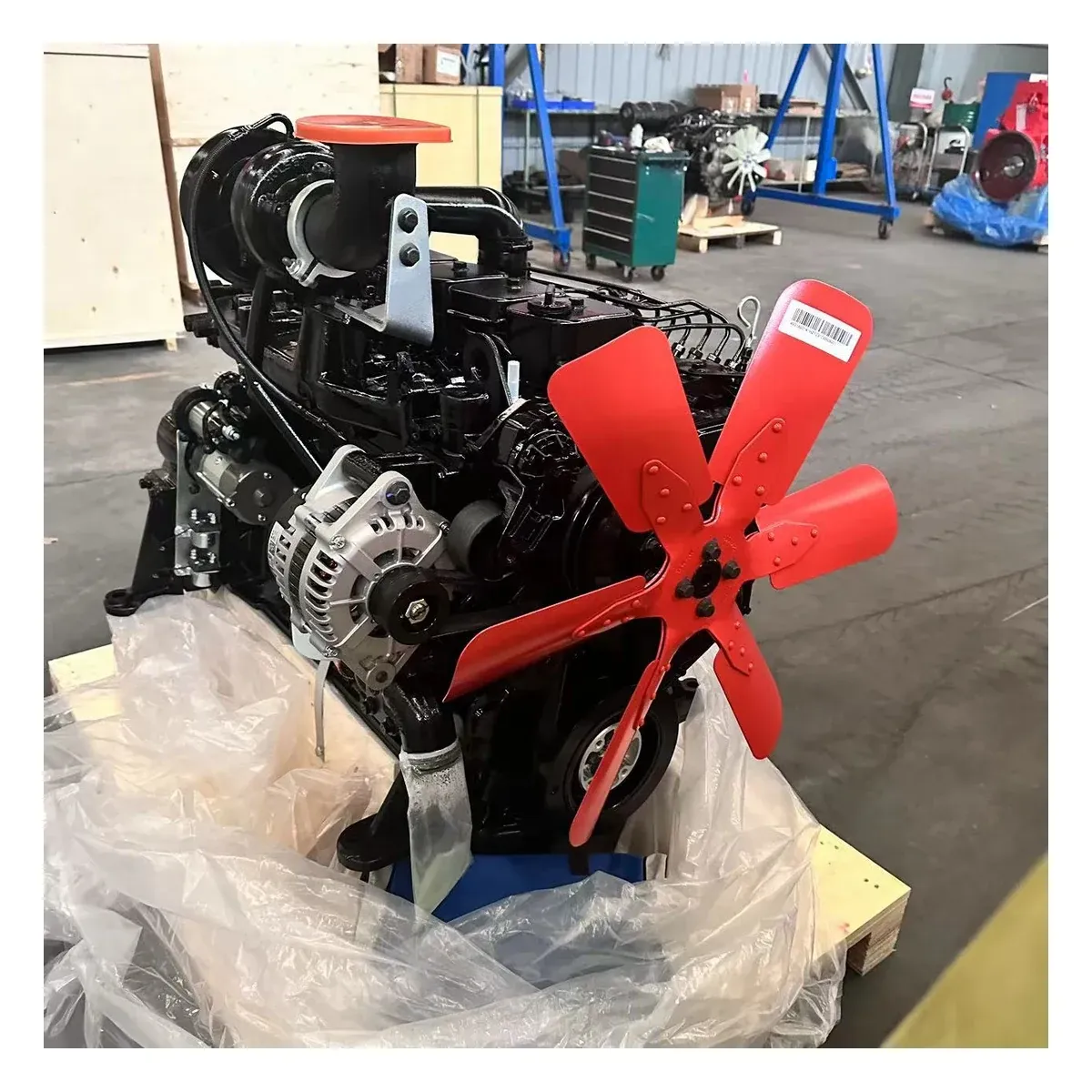
The Cummins 6BT is one 5.9-liter, six-cylinder diesel with two lives: America's pickup legend, and the industrial workhorse behind pumps, generators, boats and loaders worldwide. We stock the industrial side as twelve builds across forty factory ratings, 107 to 205 hp. Same block. The rating decides everything.
Search cummins 6bt engine and you meet three communities that barely link to each other. Pickup forums argue valve counts and injection pumps. Spec aggregators publish weight and oil capacity as single rows in a table. Indian truck boards discuss the same engine as a Tata-era fixture. All three are talking about one platform, and none of them is talking to the others. This page is the hallway between them: what the badge decodes to, why the horsepower figures on American sites differ from our industrial figures, which of the twelve builds we stock fits the job you have — and where this page deliberately refuses to print a number.
The Family Ladder: Twelve Builds, One Displacement
Start with the iron, because it never changes: 5.9 liters — 359 cubic inches — six cylinders [1]. The breathing changes with the badge, and the shelf splits along it, so that is how I will show it: turbocharged builds first, then the two aftercooled lines.
6BT5.9 — turbocharged
6BTA5.9 — turbocharged and aftercooled
6BTAA5.9 — the double-A line
Build | Job | Factory ratings | Horsepower |
|---|---|---|---|
construction machinery | 7 | 130–205 | |
generator-set drive | 2 | 161–188 | |
marine propulsion | 1 | 161 | |
pump drive | 3 | 160–190 |
One badge that breaks the pattern
Build | Job | Factory ratings | Horsepower |
|---|---|---|---|
generator-set drive | 3 | 115–173 |
Every figure comes from the product pages of builds we stock [1] — twelve builds, forty factory ratings, one displacement, each engine nameplate-verified before it leaves. This is stock you can order against, not storytelling.
Read the table by its edges. The turbo-only 6BT stops at 160 hp, and it stops at pump duty. Everything above 180 hp belongs to a double-A badge. The smallest number on the shelf, 107, belongs to a boat. The construction rows, meanwhile, exist only on aftercooled builds — our shelf carries no turbo-only construction rating. And notice how narrow the generator rows run: two ratings here, one there, three on the B5.9CS4. A genset turns at one speed and is specified against a kilowatt target, so its ladder collapses into a step. Pump and marine rows are ladders, because those jobs get matched rating by rating.
The B5.9CS4 deserves one honest sentence. It leads with B, carries no T at all, and still turns a generator at 115 to 173 hp [1]. I could invent a confident story about those letters, and it would remain exactly that — a story. The build's own product page and its data sheet are the record.
Reading the Name — and the Pickup Legend
The badge is a parts list, read left to right. The 6 is the cylinder count — this is the six-cylinder branch of Cummins' B series, with a four-cylinder sibling below it. T adds the turbocharger. A adds air-to-air aftercooling: charge air runs through a heat exchanger before it enters the cylinders, and cooler, denser air is how one displacement carries a wider spread of ratings. The second A in 6BTAA applies the rule once more; the double A marks the aftercooled configuration line. Our guide to Cummins engine models and naming decodes the rest of the range, N through K50.
One thing I will not do is invent depth. On our product pages, the Aspiration field for the 6BTA5.9 and the 6BTAA5.9 reads the same: turbocharged and aftercooled [1]. The letters tell you that both breathe through a turbo and an aftercooler. Whatever else separates the two lines lives inside the specific rating — its configuration, its CPL, its data sheet — not in a name rule I can responsibly print. When a seller claims the second A stands for something precise, ask for the document that proves it.
The suffix is the job. -G turns a generator, -M drives a shaft, -P bolts to a pump, and the plain badge — 6BTA5.9, 6BTAA5.9 — is the construction build.
And then there is the legend, which is where the numbers start to misbehave.
From 1989 the Dodge Ram offered the 5.9 Cummins, and the 12-valve mechanical era that ran through 1998 — by the community's own dating — built a reputation the forums still trade on. From mid-1998 came the 24-valve electronic ISB [5]. Valve counts, injection pumps, wiring: the argument has run for decades, and 4BTswaps' long-standing summary still holds — the right generation depends on what you want from the engine, mechanical simplicity on one side, finer electronic control on the other [5]. That is pickup-world framing, and it matters on an industrial page for one reason: those trucks are why a pump-station buyer on another continent has heard of this engine at all.
Now the confession this page owes you. The horsepower figures American pickup sites attach to the 5.9 do not transfer to the builds on our shelf — not because anyone is exaggerating, but because they are different contracts with the same iron. A pickup rating buys high output for short, hard running behind a road gearbox. Our industrial ratings buy sustained load, hour after hour, in a pump station or on a fishing hull. A high-output rating pays for its peak with shorter service intervals; a continuous rating pays for its running hours with a lower peak. The duty class is part of the rating itself — rated speed, workload profile, service expectations, all printed alongside the number. Our marine engines guide shows the same mechanism across the whole marine range, where the duty classes carry formal names.
There is a cost to how this platform earned its legend, and it is worth naming: the reliability is a product of conservatism. The ceiling is designed. Modest power per liter, heavy internals, ratings set with headroom — that is what you are actually buying, and it is why the engine's reputation outlasted the trucks that carried it. A build rated at its edge does not become nostalgia.
Buy the rating, not the myth.
Weight and Oil Capacity: The Two Searches This Page Answers Carefully
Two of the most common searches around this engine ask for its weight and its oil capacity, and both deserve a straight answer: there is no single honest number.
The weight moves with the configuration. A bare long block is one thing; add the flywheel housing your application needs, the cooling pack, the mounting arrangement, the aftercooler plumbing, marine gearing where relevant — and the figure moves with every choice. Oil capacity behaves the same way, following the oil pan and the application package the build was sold with. A weight or a capacity quoted without a build attached is trivia. On a skid design, a lifting plan or a stability calculation, it is worse than trivia: it is a number you trusted.
We are not hiding anything. The figure belongs to a build, and we would rather hand you the right one than a popular one.
So which number is right? The one registered against the specific engine. Every Cummins engine carries an engine serial number and a CPL code, and together they pull the factory data sheet for that exact configuration — including the figures this page deliberately leaves out — from QuickServe Online, Cummins' free owner database. Our QuickServe Online walkthrough shows the lookup step by step. If you would rather not set up an account, ask us instead. Send the nameplate photo and we will read the build and pull its data sheet.
The 12V Reputation — and Where We Stop
The cult following is not marketing. A Cummins Forum owner sizing up swap candidates put it flatly: in his view, the '92 to '97 12-valves with the VE pump have no cons [2]. An IH8MUD thread judges the same engine from the other side of affection — heavy, tall and noisy, and in the same breath powerful, economical, reliable, simple and proven [4]. On Steel Soldiers, a member's 6BT swap has covered more than 15,000 miles on mostly stock wiring [3]. Three forums, three contexts, one drift: the reputation was earned in the field, not in a brochure.
An industrial buyer should take one thing from all this, and it is not nostalgia — it is infrastructure. An engine this widespread carries a global parts ecosystem, mechanics on several continents who have had one apart, and a documentation trail the forums have collectively memorized. When your pump station sits a day's drive from the nearest dealer, that informal network is a real platform feature. No competitor's spec sheet prices it in.
The flip side is the conservatism named above: modest power per liter, a ceiling set on purpose. If your specification demands the last horsepower out of every liter, or full electronic self-diagnostics, the 6B platform is the wrong shortlist — better you hear that here than after the invoice.
One boundary, stated once: we supply the industrial builds on this page, and we do not do pickup conversions or swap packages. The forums above are the right home for that project.
Tata Cummins: The Same Block, Another Factory
In India, the 5.9 has a life of its own. Team-BHP's truck community treats the 6BT as an established model there, credits Tata's long preference for it in heavy trucks, and debates what stepped-up emission stages mean for an aging mechanical platform [6]. Performance data pages for Tata-era 6BT builds circulate on document-sharing sites such as Scribd [7] — thin provenance, clear signal: the demand is real.
Much of that production sits with Tata Cummins, Cummins' joint venture with Tata Motors in India. Our builds come from a different line. We are an authorized distributor of DCEC (Dongfeng Cummins), and the 5.9-liter engines on this page sit inside DCEC's 3.9-to-13-liter range.
Same platform, different factory.
The verification does not change with the geography: nameplate, engine serial number, CPL, QuickServe Online. Our guide to verifying a genuine Cummins engine walks that check in order, and it applies to a Tata-built 6BT exactly as it applies to one of ours.
Manuals, Data Sheets and Parts
Three legitimate routes to a 6BT manual, and none of them ends in a stranger's upload. First, QuickServe Online — a free owner account, your engine serial number, and the owner's literature and parts data registered against that engine. Second, official channels: data sheets and service literature come through Cummins' publication system and its distributors. Anything else is a photocopy of uncertain vintage. Third, us: send the nameplate photo, we identify the build, and the factory data travels with the quote. We do not host or reproduce copyrighted manuals.
Parts follow the same discipline — matched to the serial number before anything is quoted, as our genuine parts guide explains.
Which 6B for Which Job
Four directions, one shelf. Find your row:
The job | What the duty asks of a 5.9 | Start here |
|---|---|---|
Construction machinery — loaders, excavators, drill rigs | load swings, idle time between cycles, service measured in years | |
Generator sets — prime and standby power | one speed, long hours, matched to a kilowatt target | |
Marine propulsion — small workboats and fishing craft | steady load for long hours, ratings classed by duty | |
Pump drive — irrigation, dewatering, transfer | season-long steady speed against a head |
The marine row carries one extra decision, because marine ratings are classed by how hard and how long the engine works; the marine engines guide mentioned above covers the duty classes in full. If the engine is already on your floor — inherited with a plant, bought used, mid-negotiation — the listing title matters less than the nameplate. Check the build while the deal can still move.
Two boundaries close the ladder. Below this platform sits the four-cylinder 3.9 — the 4BT — for jobs that fit in four cylinders; our 4BT guide picks up that thread. Above it, the same build-and-rating logic scales through the C, L, N and K families, and our KTA19 guide is this same tour at 19 liters.
Before You Go
The badge tells you how the engine breathes. The job tells you which build. The rating tells you everything else — and the rating is the part a seller can quote.
Send us the nameplate photo and we will read the build and pull its data sheet, including the figures this page deliberately leaves out. Or request current pricing and availability for the build you have already settled on. You will find no prices here: they move with build, rating and freight, and a number frozen into a blog post goes stale long before it is useful. The full engine range is one click away while you wait.
Same block. The rating decides.
Frequently Asked Questions
How much horsepower does a Cummins 6BT have?
It depends on the build, because 6BT names a platform, not an output. The industrial builds we stock run 107 to 205 hp across twelve builds and forty factory ratings [1]. The pickup engines that made the platform famous are rated on a different, high-output automotive duty class — the numbers describe different ratings, not different facts. Buy against the duty first; the horsepower follows.
What is the difference between 6BT, 6BTA and 6BTAA?
The letters record how the engine breathes: T adds the turbocharger, A adds air-to-air aftercooling, and the second A in 6BTAA marks the aftercooled configuration line. On our product pages, both aftercooled builds list the same Aspiration field — turbocharged and aftercooled — so configuration differences beyond that live in the specific rating's data sheet, not in the badge. Ask for the data sheet or the CPL before you take anyone's decoding on faith.
How much does a Cummins 6BT weigh?
There is no single honest number. Weight moves with the flywheel housing, cooling pack, mounting arrangement and the rest of the configuration the build was sold with, which is why we do not print forum ranges. The official figure sits on the data sheet for the specific build — pulled by its engine serial number and CPL from QuickServe Online, or we can send it with the quote.
What is the oil capacity of a 6BT?
Same answer, same reason: capacity follows the oil pan and the application package, so no figure without a build attached is worth printing. The registered capacity for a specific engine is on its factory data sheet — QuickServe Online holds it against the serial number, or ask us and we will pull it for you.
What is the difference between a 12V and a 24V 6BT?
That is pickup-community shorthand for the truck generations: the 12-valve mechanical engines of 1989–1998 and the 24-valve electronic ISB that followed from mid-1998 [5]. The community's own summary holds — 12V for mechanical simplicity, 24V for finer electronic control, decided by what you want from the engine. Our industrial builds are specified by the T/A badge and the factory rating, not by valve count.
What is a Tata Cummins 6BT?
A 6BT built by Tata Cummins — Cummins' joint venture with Tata Motors in India — a mainstay of the Indian truck market [6]. Our 5.9-liter builds come from DCEC, a different factory on the same platform family. The verification method is identical wherever the engine was built: nameplate, serial number, CPL, QuickServe Online.
Where can I get a Cummins 6BT manual?
Three legitimate routes. QuickServe Online — a free owner account that pulls the owner's literature and parts data registered against your engine serial number. Cummins' official publication channels and distributors, for data sheets and service literature. Or ask us: send the nameplate photo and we will identify the build and pull its factory data. We do not host or reproduce copyrighted manuals.
Do you sell 6BT engines?
Yes — the twelve builds in the tables above are our working shelf: builds we can quote, test and ship, each one nameplate-verified before it leaves [1]. Send the build and rating you need and we will confirm availability with current pricing.